Walk into most institutional buildings constructed in India over the past three decades, and you will notice a familiar, rigid pattern: thick concrete facades, narrow corridors that restrict airflow, and air conditioners running at low temperatures even after summer.
The reason is simple. Institutional construction in this country has long been evaluated on one number, cost per square foot. Everything else, comfort, air quality, how much the building costs to run, how well children actually learn inside it, has been someone else’s problem.
The IGBC Green Campus rating system approaches school design differently. A campus isn’t a collection of separate blocks, it’s a system, and every part of it affects every other part. For school boards and institutional developers, the case for this isn’t primarily environmental. It’s financial, and it shows up in learning outcomes.
The Energy Drain: Where Conventional Indian School Buildings Waste Capital
A typical school building in western India, Gujarat’s climate in particular, runs an Energy Performance Index somewhere between 90 and 130 kWh/m²/year. Two things drive most of that consumption: lights compensating for classrooms that don’t get adequate daylight, and air conditioning working against buildings that were never designed to manage heat in the first place.
IGBC-aligned campuses bring that figure down by 20–30%, not with expensive systems, but with decisions made at the drawing board stage. By integrating energy-efficient institutional design right from the start, architects use passive strategies to tackle heat before any mechanical equipment enters the picture.
Three examples:
- Orientation: A building positioned to cut off western and southern solar exposure while drawing in southwest winds reduces cooling loads by 15–18% before any mechanical equipment enters the picture.
- Roof coatings: In Gujarat summers, roof surfaces routinely hit 65–70°C. Reflective coatings bring that down by 20–25°C. Less heat at the roof means less heat pushing through into the rooms below.
- Cavity walls: A double-skin wall with an insulated cavity stops the slow thermal transfer that bleeds through solid construction all day. Combined with proper shading, peak cooling demand drops by up to 22%.
The Numbers
For a 500-student campus, a 25% reduction in energy use means roughly ₹8–12 lakhs less per year on electricity bills. Held over thirty years, that’s a significant return on what is usually a modest increase in initial design investment.
The Learning Dividend: How Sustainable School Design Boosts Student Focus
The utility savings are real, but they’re not the most important part of this conversation.
Children spend six hours a day inside school buildings. What those buildings do to their ability to concentrate, absorb information, and stay mentally present is worth taking seriously.
Daylight and How It’s Managed
Classrooms with good natural light produce measurably better concentration, steadier sleep patterns in students, and less eye strain. This is well-documented and not particularly surprising, humans have always functioned better in natural light than under tubes.
The design response to this isn’t simply adding windows. Direct sunlight brings heat. The better approach uses deep overhangs (chajjas), perforated jaali screens, and louvers to bring in diffused north light, enough to work by, without turning the room into a greenhouse.
Carbon Dioxide Is the Problem Nobody Talks About
A classroom of forty students with poor ventilation will typically see CO₂ levels climb to 2,000–3,000 ppm by early afternoon. Cognitive decline becomes measurable above 1,000 ppm. The mid-afternoon slowdown that teachers know well, students losing the thread, responses getting sluggish,is frequently not about the time of day. It’s about what’s in the air.
The fix doesn’t require mechanical ventilation systems. Passive stack shafts and wind catchers, designed into the building from the start, maintain continuous air exchange and keep CO₂ in the 800–1,000 ppm range where the brain functions properly.
Case Study: Passive Architecture in Action at Sumandeep Vidyapeeth, Gujarat
The Sumandeep Vidyapeeth campus in Gujarat, designed by Harmony Planning Services, puts these principles into a real institution.
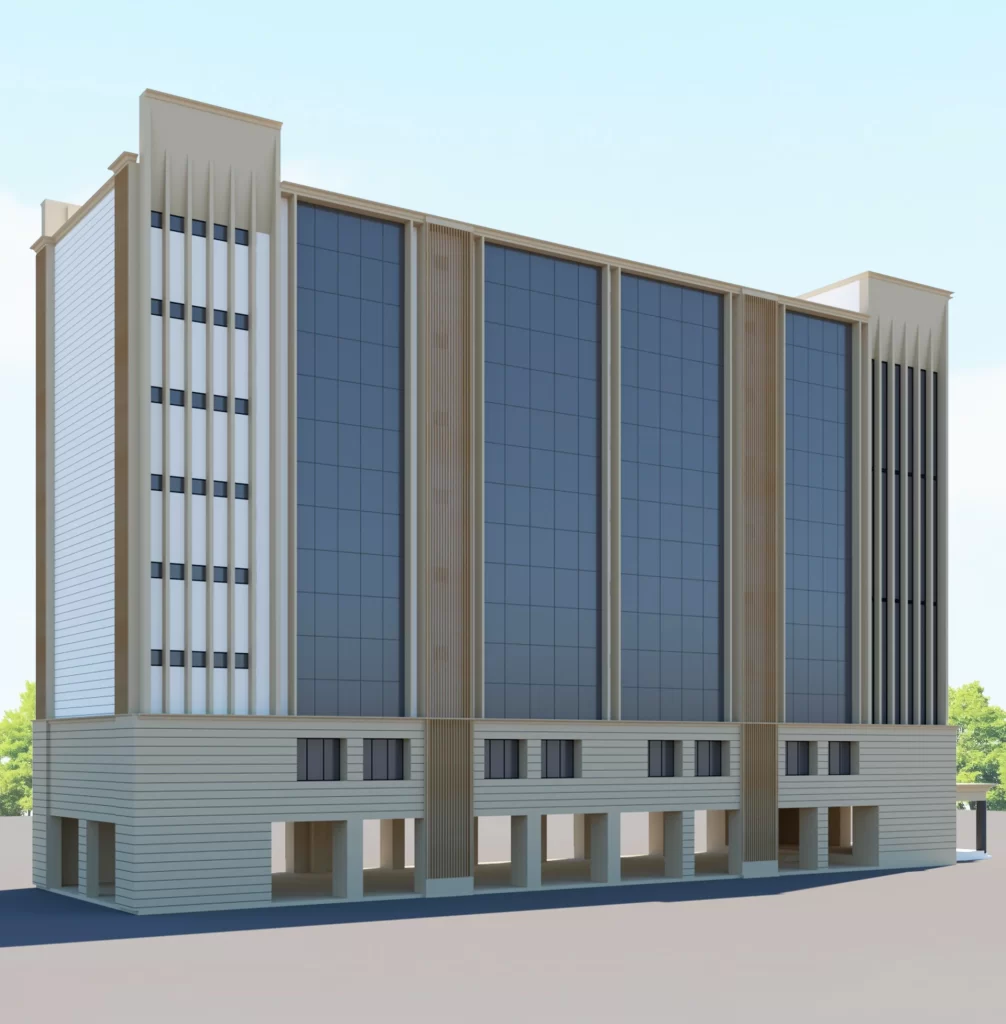
Instead of the standard concrete plazas and hard-paved courtyards, the design used landscape as a thermal tool: native planting, tree-lined paths, and permeable ground surfaces. Measured surface temperatures in those landscaped zones run 6–8°C cooler than equivalent paved areas nearby. Rainwater harvesting captures the monsoon for irrigation and non-potable use, reducing reliance on tanker supply during dry months. Building placement and passive cooling in the common areas mean the HVAC load is a fraction of what a conventional facility of that size would require.
The IGBC certification is the formal outcome, but what it represents is a campus where the thermal environment, the light, the acoustics, and the water management are working as a coherent whole rather than fighting each other.
The Long-Term Financial Case for IGBC Green Campuses
A well-designed building costs less to run from day one and keeps costing less for its entire life. The additional investment in getting orientation, insulation, ventilation, and landscaping right in the design phase pays back within the first few operational years.
Beyond the finances, there is the less-discussed question of what kind of environment an institution is asking its students to spend their formative years in, and whether the building is helping or quietly working against them.
If your institution is planning a new campus or an expansion, the Harmony Planning Services institutional portfolio is worth a look for how this kind of thinking translates into built, functional educational environments.